
When a platform owner hears that an AI product writes to their ServiceNow instance, the reaction is rarely enthusiasm. It is a question, and usually the same question: you let an AI do what?
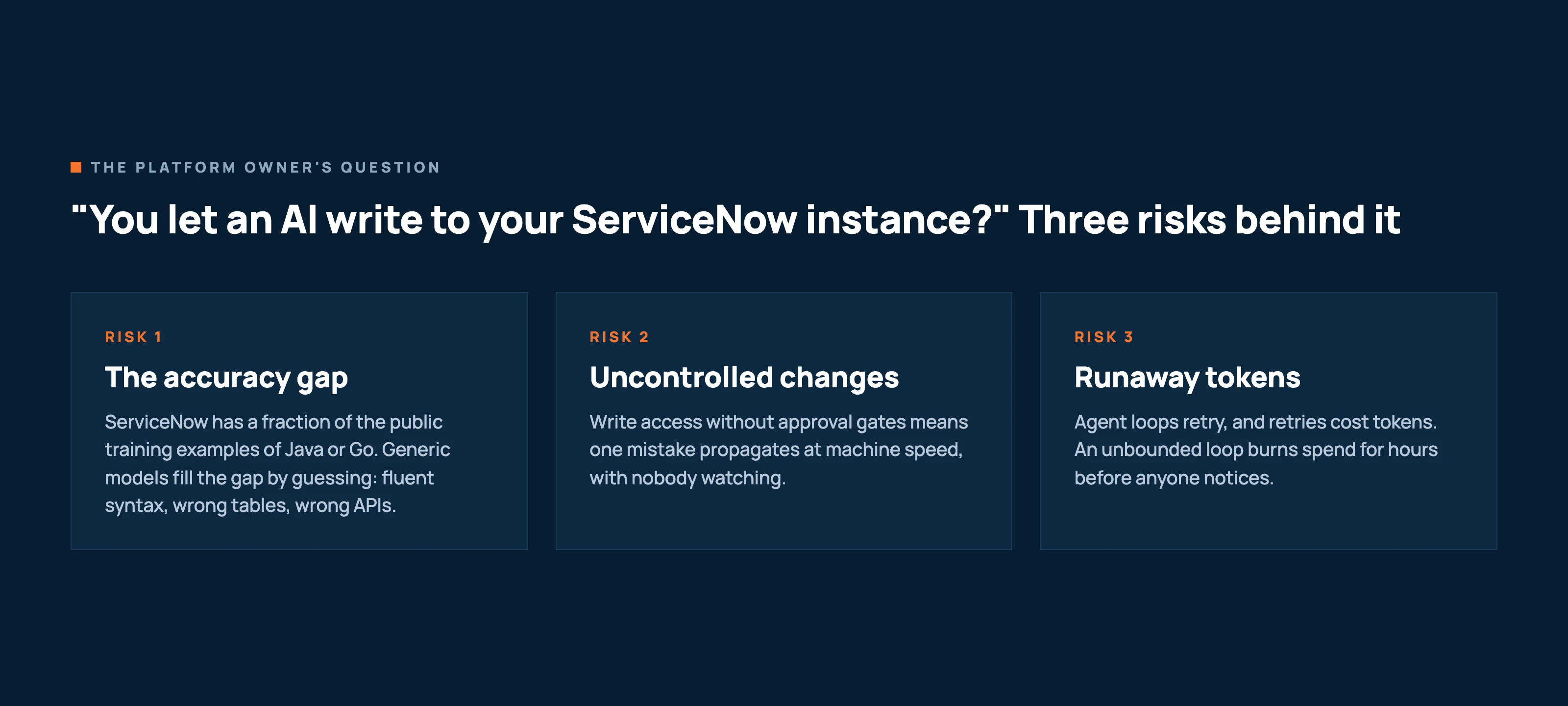
It is a fair question, and it deserves a specific answer rather than reassurance. In our experience the concern breaks down into exactly three risks: the code might be wrong, the changes might be uncontrolled, and the spend might run away. Each one is real. Each one has also been engineered out of how SnowCoder works, and this post walks through both halves: why the risk exists, and what contains it.
Risk 1: The accuracy gap
Java and Go gave the frontier models millions of public code examples to learn from. ServiceNow gave them a fraction of that. Most of what exists publicly is tutorial-grade, and almost none of it covers the newer surfaces like the Fluent SDK. Generic GPT and Claude fill that gap the only way a language model can: by guessing. The guesses look plausible, which is precisely the problem. Invented Fluent syntax, wrong tables, wrong APIs, wrong behaviour on edge cases the tutorials never covered.
In our testing, 20-30% of the ServiceNow code that generic models produce contains errors of this kind. That is not a knock on the models. As we argued when we looked at why even Claude Fable 5 cannot reliably build ServiceNow from a user story, capability is not the bottleneck. Training data coverage and instance context are, and no amount of raw intelligence puts back what the training corpus never contained. The same dynamic is why generic LLMs land far below a grounded system on ServiceNow-specific work.
Why a 25% error rate is worse than it sounds
Here is the part most evaluations miss. A 20-30% per-artifact error rate sounds tolerable: a developer reviews the output, catches the bad one in four, moves on. That intuition holds for a single snippet. It collapses for a story.
A real user story is almost never one artifact. It is a table change plus a business rule plus a UI policy, or a flow plus a script include plus an ACL. For the story to be right, every artifact has to be right, and independent error rates compound:
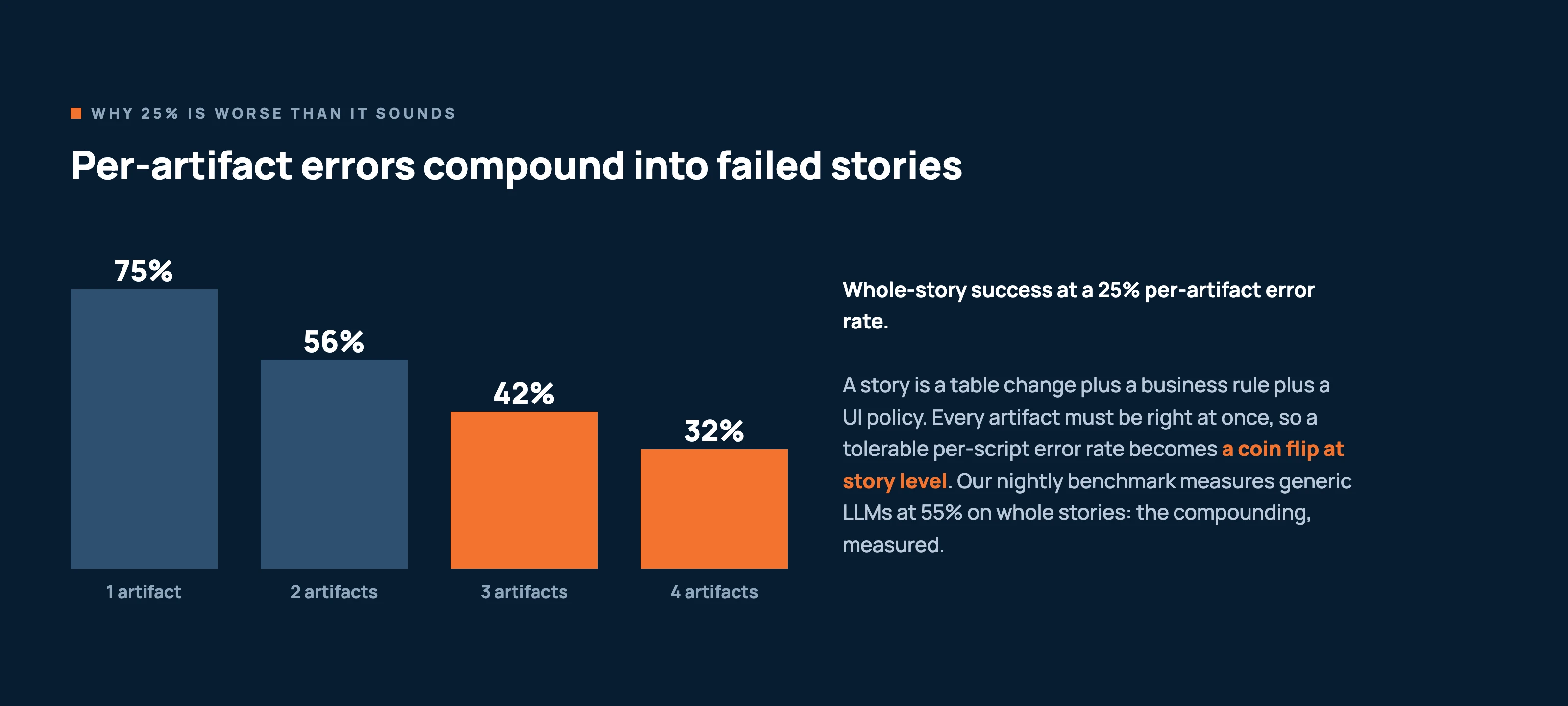
A 25% per-script error rate feels manageable right up until you need three or four scripts to all be correct at once, and whole-story delivery drops to a coin flip or worse. This is why per-snippet AI assistants feel fine in daily use while whole-story AI delivery keeps disappointing: the per-snippet experience genuinely is fine, and the compounding is invisible until you measure at the story level.
It also explains why our two headline numbers differ, because they measure different things. The 20-30% figure from our testing is a per-artifact code error rate. Our nightly benchmark instead measures whole-task accuracy on full user stories, and there generic LLMs score 55%. If each artifact carries a 20-30% error chance, a story needing two to three artifacts comes out right roughly 42-56% of the time. The benchmark number is the compounding, measured. And it is the core argument for verifying at the pipeline level, story by story, rather than eyeballing snippets one at a time.
The guardrail: grounding beats guessing
SnowCoder closes the accuracy gap by wrapping the model in what ServiceNow's public internet never gave it: a 100,000+ vector ServiceNow knowledge base, 17,000+ curated code examples, and live context from your connected instance. The model stops guessing at table names and API signatures because it no longer has to.
On the same nightly benchmark where generic LLMs score 55% on whole-story ServiceNow accuracy, SnowCoder scores 87%. The remaining distance is closed by the pipeline itself: the 10-stage Yeti Build Agent pipeline verifies every story against its acceptance criteria and auto-heals failures until they pass or are surfaced for remediation, which is what the 291-story build benchmark checks nightly. Grounding lifts the floor; verification and healing finish the job.
Risk 2: Uncontrolled changes
An AI with write access to a production platform and no approval gate is a platform owner's nightmare, and rightly so. The fear is not that the AI is malicious. It is that it is fast, tireless, and confident, which means a mistake propagates at machine speed with nobody watching.
The answer is human-in-the-middle, by design. In SnowCoder, the AI proposes and humans dispose. Nothing deploys without a named person approving it, and the control is not one gate but a set of them:
- Human approval between spec and build. The Yeti Build Agent will not start building until a person has reviewed and approved the backlog it produced from the brief. The scoped app build walkthrough shows where this sits in practice.
- Warn-and-confirm on destructive changes. Deletions, schema removals, and bulk overwrites pause the run and come back to a human with the full diff, record counts, and blast radius. We wrote up the mechanics in the destructive-change confirmation post. There is no override flag and no "trust me" mode.
- Update set and rollback on every change. Every change lands with a reversal path, so approval is never a one-way door.
- Scoped-app isolation. Builds land in their own scope. Out-of-the-box tables are not touched without explicit, logged human approval.
Underneath the gates sits an architectural separation: humans work interactively in Yeti Chat while agents run on schedule in their own lane, a split we covered in the two-lane model. Nothing drops a table, removes a field, or rewrites a script without a person saying yes.
Risk 3: Runaway tokens
The third risk is financial. Agentic systems retry, and retrying costs tokens. An agent loop that burns spend for hours before anyone notices is an enterprise horror story, and it is not hypothetical: any retry loop without a hard limit will eventually find the input that makes it spin.
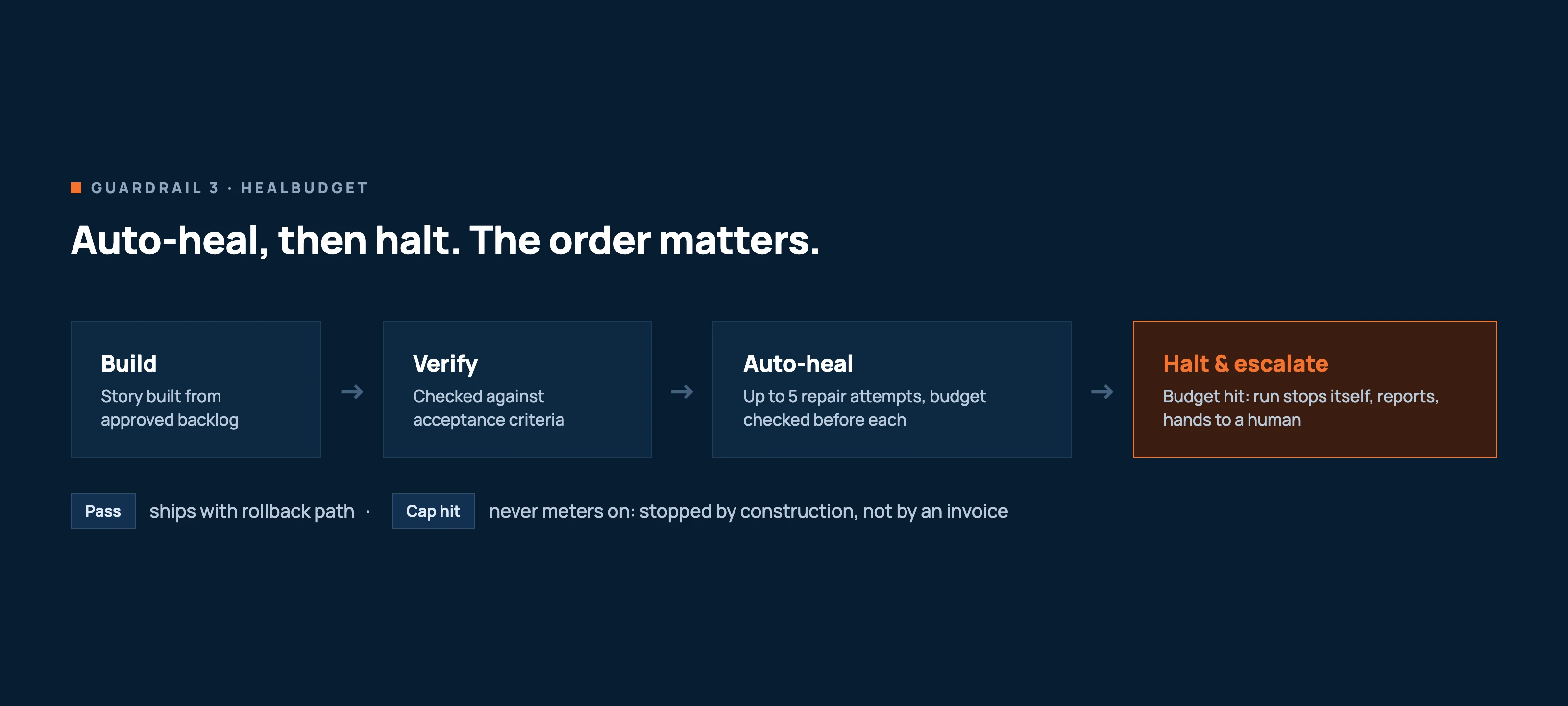
SnowCoder's answer is HealBudget: every build carries a hard token budget that the heal loop cannot exceed, checked before each attempt rather than after. Within that budget, the agent auto-heals failures, up to five repair attempts per story. Then it halts. A run that hits the cap stops itself, produces a report explaining what failed and what the next attempt would have cost, and escalates to a human. It never guesses its way onward, and it never meters on.
Auto-heal, then halt. The order matters. You get the benefit of self-repair, which is what makes autonomous builds economical, without the exposure of an open-ended loop. A misbehaving run is stopped by construction, not by someone spotting an invoice.
The closing guardrail: prove it shipped right
Guardrails during the build are only half the answer. The other half arrives after deployment, when someone asks the question every governance process eventually asks: prove it. Not "it deployed". The requirement is met.
In SnowCoder, every requirement is traced from the original user story, through the build agent pipeline, to the deployed code. An independent super-audit then verifies the acceptance criteria one by one before sign-off, with a full audit trail behind each verdict. The per-AC translation diff is the artefact that makes this reviewable: for each AC, you can see what was built to satisfy it and how it was verified.
This is the same discipline that separates "the code runs" from "the code does what the story meant", and it is deliberately independent of the generation step. The agent that built the code is not the judge of whether the requirement is met.
Fail-closed, by design
Put the three risks and their guardrails side by side and a pattern emerges:
| Risk | Guardrail | Failure mode |
|---|---|---|
| The accuracy gap | Grounding plus pipeline verification | Unverified stories fail, they do not ship |
| Uncontrolled changes | Human-in-the-middle approval gates, rollback, scoped isolation | No approval, no deploy |
| Runaway tokens | HealBudget hard cap, auto-heal then halt | Budget hit, run stops and escalates |
Every guardrail fails closed. When something goes wrong, the system stops and hands control to a person, rather than pressing on and hoping. That is the honest answer to "you let an AI write to your ServiceNow instance?": yes, with the risks engineered out, and with the evidence to show for every story it ships. The full picture of how the gates fit together is on the Yeti Build Agent page, and the numbers behind the accuracy claims are on the benchmarks page, verified nightly.