
The 60% Number Is About Accuracy, Not Model Quality
Yeti Chat is 60% more accurate than generic ChatGPT or Claude across 120+ ServiceNow benchmarks. Those benchmarks cover Business Rules, Client Scripts, ACLs, Script Includes, Scheduled Jobs, Flow Designer actions, Fix Scripts, REST integrations, ATF tests, and the 42 artifact classes available through the ServiceNow Fluent SDK.
The gap is not because the underlying frontier models are bad. It is because ServiceNow code has very specific failure modes that generic LLMs hit again and again. Six failure modes account for most of the gap.
This article walks through each one with examples, then explains how Yeti is engineered to avoid them.
Failure Mode 1: Hallucinated Tables and Fields
Generic LLMs do not know your instance. They will happily reference table names like incident_extended or fields like u_root_cause_summary that do not exist in your data model. The result compiles in the editor and fails the moment it runs.
Yeti Chat is connected to the actual instance through OAuth. Tables, fields, choice values, and ACLs are read from the live dictionary before code is drafted. When Yeti writes a GlideRecord, the field names are real.
// Generic LLM output - assumes fields that may not exist
var gr = new GlideRecord('incident');
gr.addQuery('u_root_cause_summary', 'CONTAINS', 'database');
gr.query();

// Yeti output - grounded against the live dictionary
var gr = new GlideRecord('incident');
gr.addQuery('close_notes', 'CONTAINS', 'database');
gr.addActiveQuery();
gr.setLimit(100);
gr.query();
Failure Mode 2: Wrong API Surface for the Release
ServiceNow APIs change. The Fluent SDK in Zurich exposes artifact classes that did not exist in older releases. Some scoped APIs are deprecated. Some global APIs are restricted in scoped applications.
Generic LLMs train on a mix of release-specific documentation, blog posts from multiple eras, and Stack Overflow threads that may be five years old. They blur all of that into a single answer.
Yeti is grounded against SnowCoder's supported release set, starting with Zurich. When you ask for a Fluent SDK Business Rule, the output is checked against the current SDK and artifact definitions. When you ask for a deprecated workflow API, Yeti routes you to the supported alternative.
Failure Mode 3: ACL and Security Misunderstandings
ACL logic on ServiceNow is layered: table, field, record, and security plugin behavior all interact. Generic LLMs frequently produce ACL scripts that look right but evaluate in the wrong order or skip required conditions.
// Yeti ACL pattern - explicit, defensible, and readable
// Read ACL on incident.priority for non-admin users
answer = false;

if (gs.hasRole('itil')) {
    answer = true;
} else if (current.caller_id == gs.getUserID()) {
    // Caller can see their own incident's priority
    answer = true;
}
Yeti is grounded on the security patterns documented in the SnowCoder knowledge base and validated against the 500+ granular checkpoints used by Instance Audit. The output reflects production-grade ACL logic rather than the loosest pattern that compiles.
Failure Mode 4: N+1 GlideRecord Patterns
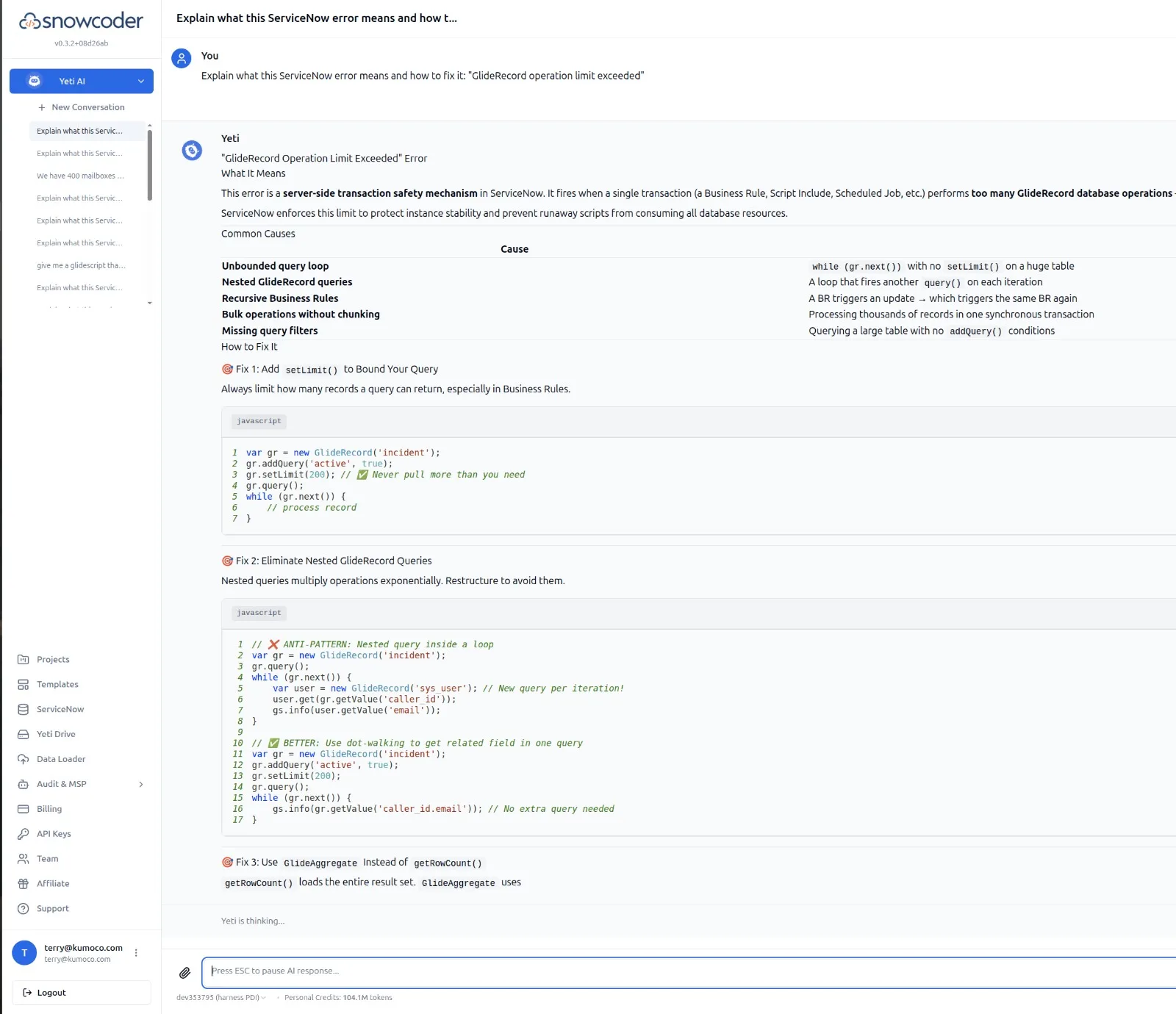
Generic LLMs love writing GlideRecord queries inside loops. On a 10-record dev table it looks fine. On a 500,000-record production table it brings the instance to its knees.
Yeti is trained on the 17,000+ curated code examples in the SnowCoder knowledge base, which were filtered for performance patterns. When Yeti generates a query that would otherwise nest, it lifts the inner query into a getMultiple or restructures it as a single encoded query.
// Generic LLM - N+1 GlideRecord inside a loop
var inc = new GlideRecord('incident');
inc.query();
while (inc.next()) {
    var user = new GlideRecord('sys_user');
    if (user.get(inc.caller_id)) {
        gs.info(user.name + ' - ' + inc.number);
    }
}

// Yeti - single query with dot-walk, no N+1
var inc = new GlideRecord('incident');
inc.query();
while (inc.next()) {
    gs.info(inc.caller_id.name + ' - ' + inc.number);
}
Failure Mode 5: Update Set Awareness
Generic LLMs treat ServiceNow code as if it lived in a single file system. They do not understand that a Business Rule, the table it references, and the ACLs that protect it must move together through the same Update Set to land in production.
Yeti Chat treats Update Sets as a first-class output. When you ask for an end-to-end artifact, Yeti packages all related records into a single update set ready for export. When you ask for a Fluent SDK project, Yeti emits a runnable npm-installable project in the right shape for the @servicenow/sdk toolchain.
Failure Mode 6: Test Coverage as an Afterthought
When asked for tests, generic LLMs produce mocha-style JavaScript that has no relationship to the ServiceNow Automated Test Framework (ATF). The tests do not run inside ServiceNow.
Yeti generates real ATF test steps with valid step IDs, scoped test data setup, and assertions that map to actual platform conditions. When the same conversation is escalated to Yeti Build Agent, the ATF Testing stage executes those tests against a target instance before the Update Set is sealed.
How Yeti Closes the Gap
The 60% accuracy improvement comes from four layered systems working together rather than a single trick.
- Grounding: a 100,000+ vector ServiceNow knowledge base covering platform documentation, security patterns, performance guidelines, and release notes for SnowCoder-supported families starting with Zurich.
- Curated examples: 17,000+ ServiceNow code examples that have been reviewed for correctness, performance, and security before being added to the retrieval corpus.
- Live instance context: OAuth-connected access to the user's tables, fields, ACLs, and update sets so the generated code matches the target.
- Validation pipeline: every artifact is validated for syntax, ServiceNow API usage, security patterns, and performance before it reaches the user.
That stack is what turns a frontier LLM from a 30-40% accuracy baseline on ServiceNow benchmarks into a 90%+ accuracy assistant for the same prompts. The model is similar. The system around it is not.