
What Eats a 10-Week Project
Pick any typical mid-sized ServiceNow delivery: a custom application with five tables, fifteen Business Rules, ten Client Scripts, half a dozen Flow Designer flows, a couple of REST integrations, and ATF coverage. In a traditional delivery model that runs to ten calendar weeks.
Most of those ten weeks are not spent writing code. They are spent on the work that surrounds the code.
- Discovery and requirement gathering: two weeks of workshops and write-ups.
- Technical specification: one week of design, review, and sign-off.
- Data model and schema design: half a week of debate, half a week of build.
- Business logic implementation: two weeks of Business Rules, Script Includes, and Flow Designer flows.
- Frontend configuration: a week of forms, Service Portal widgets, and UI Policies.
- Integration: a week of REST work and authentication wiring.
- Test build: a week of writing and running ATF and manual scripts.
- Update Set hygiene, security review, and deployment: a week split across release windows.
The actual coding is maybe two weeks of the ten. The rest is coordination overhead.
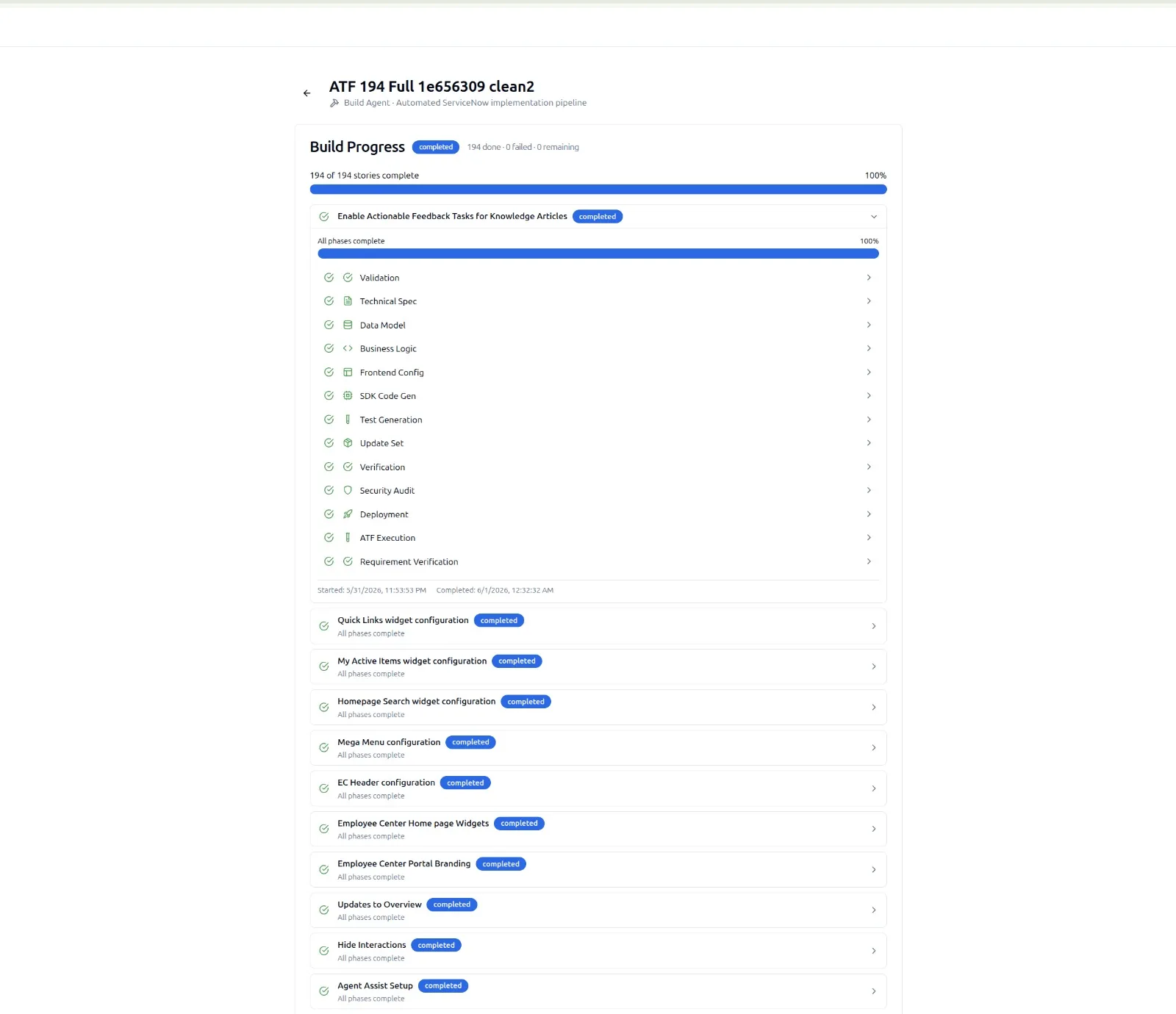
How Yeti Build Agent Compresses the Same Work
The SnowCoder Yeti Build Agent runs the same delivery as a single 10-stage pipeline. Each stage produces a verified artifact that feeds the next stage. There are no meetings, no handoffs, and no waiting for the next team to free up.
- Validation: stories from the backlog are parsed, checked for ambiguity, and rejected back to the author if they are not testable.
- Technical Spec: a per-story spec is generated against the live instance schema.
- Data Model: tables, columns, choice lists, and relationships are defined as Fluent SDK artifacts.
- Business Logic: Business Rules, Script Includes, Scheduled Jobs, and Fix Scripts are generated.
- Frontend Config: forms, lists, UI Policies, UI Actions, and Service Portal widgets are configured.
- Fluent CodeGen: the full set of artifacts is emitted as a @servicenow/sdk project ready to install.
- ATF Testing: ATF tests are generated and executed against the target instance.
- Update Sets and Verification: a clean Update Set is built and validated.
- Security and Script Audit: the bundle is scanned against the same 500+ checkpoints used by Instance Audit.
- Deployment: the verified bundle is shipped to the chosen target instance.
Each stage is observable. Each stage can be paused, reviewed, and resumed. The entire pipeline runs in hours rather than weeks.
Week-by-Week Comparison
The clearest way to see the compression is to map the same project against the two delivery models.
| Activity | Manual Delivery | Yeti Build Agent |
|---|---|---|
| Discovery | Weeks 1-2 | Day 1 (backlog import) |
| Technical Spec | Week 3 | Day 1 (Spec stage) |
| Data Model | Week 4 | Day 2 |
| Business Logic | Weeks 5-6 | Day 2-3 |
| Frontend | Week 7 | Day 3 |
| Integration | Week 8 | Day 3-4 |
| Test Build and Run | Week 9 | Day 4 |
| Security, Update Set, Deploy | Week 10 | Day 5 |
The 10-week project becomes a 5-day project. The human time inside that week is spent on review and approval rather than typing.
The Output Is a Fluent SDK Project, Not a Set of Patches
One detail that matters: Yeti Build Agent does not emit hand-edited records. It emits a Fluent SDK project covering supported ServiceNow metadata and generated platform artifacts. That project is source-controllable, diffable, and re-deployable after target-release validation.
// Example Fluent SDK output for a Business Rule
	import '@servicenow/sdk/global';
	import { BusinessRule } from '@servicenow/sdk/core';

	BusinessRule({
	    $id: Now.ID['auto_set_priority_on_impact_and_urgency'],
	    name: 'Auto-set priority on impact and urgency',
	    table: 'incident',
	    when: 'before',
	    action: ['insert', 'update'],
	    active: true,
	    order: 100,
	    script: `if (current.getValue('impact') == '1' &&
	        current.getValue('urgency') == '1') {
	        current.setValue('priority', '1');
	    }`
	});
That output can be committed to git, reviewed in a pull request, and deployed to target instances after SDK and release-family validation. The audit trail is the repository itself.
Where Manual Delivery Still Wins
Yeti Build Agent is not a silver bullet. There are still scenarios where manual delivery is the right call.
- Stakeholder alignment in a regulated environment where in-person sign-off at every stage is mandatory.
- Novel UX patterns that have no analogue in the Fluent SDK or the SnowCoder knowledge base.
- Major architectural decisions where the trade-offs need wider human debate before any code is written.
- Legacy plugins or platform configurations that do not align with the Fluent APIs supported by the installed SDK and target release.
For everything else, the 10-week-to-1-week compression is achievable on real projects today.
Risk: Lower or Higher?
The instinctive worry is that an AI-driven pipeline introduces risk. In practice the risk profile is lower because every stage is observable and every artifact is verifiable.
The Security and Script Audit stage runs the same 500+ checkpoints used by SnowCoder's Instance Audit. The ATF Testing stage runs the generated tests against the target instance before deployment. The 291-story build benchmark validates the full pipeline nightly at 100% pass rate so regressions surface inside SnowCoder before they reach customer pipelines.
The risk in manual delivery is that an experienced developer makes a quiet mistake on a Tuesday afternoon that nobody catches until UAT. The risk with Yeti Build Agent is largely contained inside a single auditable pipeline run that can be rolled back as a single Update Set.
When the Compression Pays Off Most
Yeti Build Agent earns the biggest return when the backlog is well-defined and the work is mostly platform configuration plus standard scripting. That is the majority of ServiceNow delivery.
See the path to value page for the rollout pattern most teams use, and the workflow overview for how Yeti Build Agent fits next to Yeti Chat and the MSP Agents.